
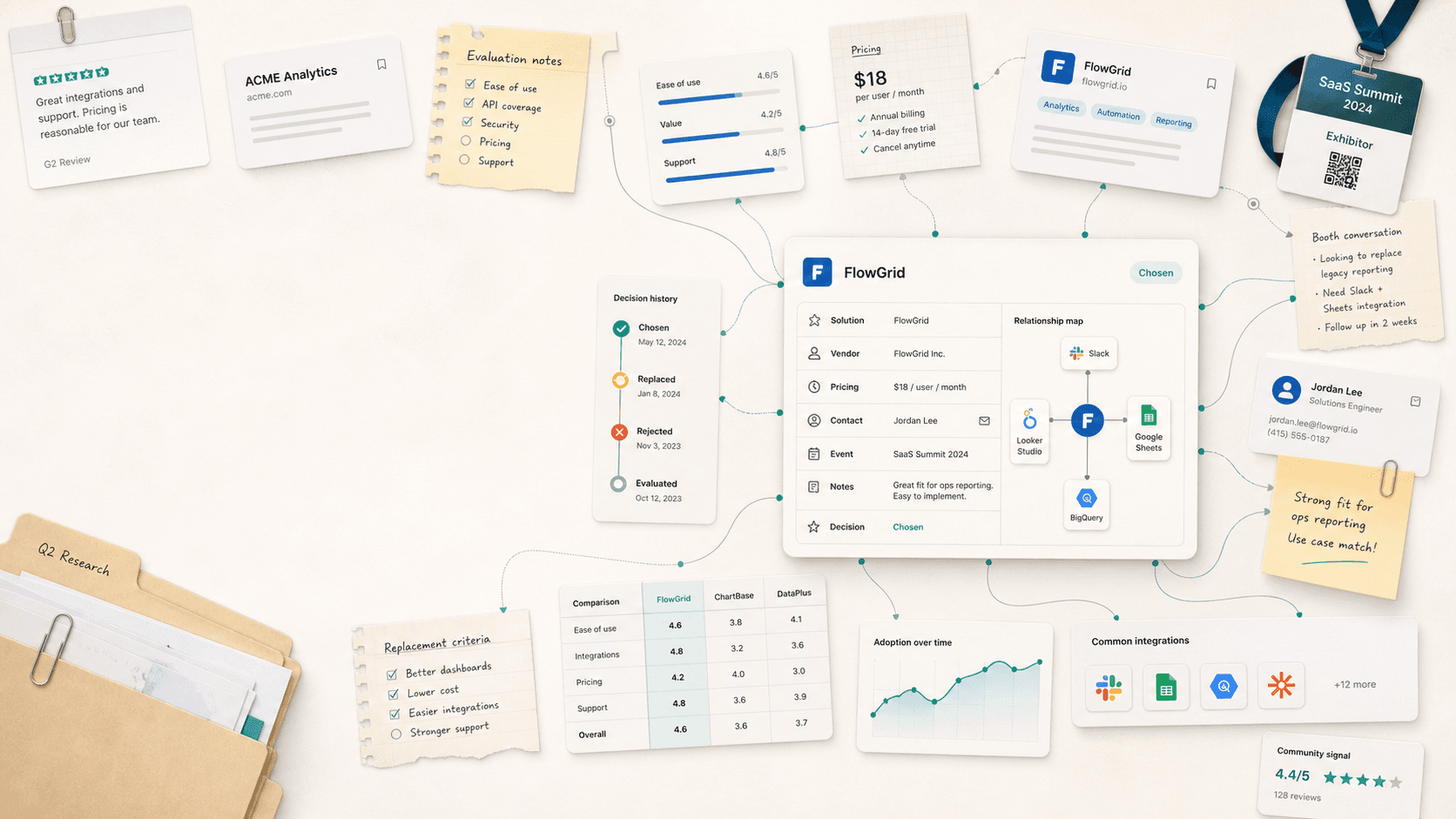
Stop losing the context behind every solution decision.
StackTrack turns vendor research, event conversations, pricing notes, contacts, and replacement history into one private decision record.
No credit card required.
Projects
8 active
Solutions tracked
142
Vendor contacts
67
Decisions recorded
412
How it flows
One record keeps the whole trail connected.
No new section has to restart the story. StackTrack follows the same object from first note to final decision.
Capture
Start with the messy inputs.
Save the product, vendor, event, contact, quote, pricing note, screenshot, or quick thought while it is still fresh.
Connect
Let the context gather around the record.
Each solution can carry notes, relationships, contacts, event conversations, ratings, integrations, and project context.
Remember
Come back to the reason, not just the outcome.
When a tool is chosen, rejected, replaced, or revisited, StackTrack keeps the trail that explains why.
Why it exists
Research usually fails after the meeting, not during the search.
Most software research does not fail because teams lack options. It fails because the reasoning disappears.
Six months after rejecting a vendor, you should still be able to see who you spoke with, what they quoted, what concerns came up, which project it was for, and why the team passed.
StackTrack gives that context a permanent home. It works as a private software evaluation tool, vendor research log, service comparison workspace, and software stack management system for teams that need more than a list of links.
Instead of spreading research across spreadsheets, browser tabs, meeting notes, Slack threads, conference badges, pricing screenshots, and inbox follow-ups, StackTrack connects each tool or vendor to the project, person, event, price, status, and decision that made it matter.
One record
Every evaluated product, service, vendor, or provider keeps its trail.
Status
Evaluating
Research note
Demo follow-up
Private pricing
Custom quote
Contact
Provider owner
- Vendor calls, demos, quotes, and event notes land together
- Status, rating, contacts, and project fit stay attached
- Chosen, rejected, replaced, or revisited all keep context
Read the full context->
StackTrack is built around solutions, not only software. A record can represent a product, service, agency, platform, marketplace, hardware vendor, or any provider your team is evaluating.
When you add a solution from search or the catalog, it becomes part of your private workspace with status, rating, strategic notes, research history, pricing, contacts, projects, and event or booth context.
That means a pricing note from a vendor call, a product demo takeaway, a provider comparison, a trade show conversation, or a replacement decision can all stay connected to the same record.
Instead of spreading solution research across spreadsheets, browser tabs, screenshots, emails, conference notes, and contact lists, StackTrack keeps the operational context together.
Private by default
Your internal context is not the public profile.
Your private notes, contacts, pricing, and internal decision history stay private. Public profiles and community signals are separate from your private workspace.
Review sites help you compare what other people say. StackTrack helps you remember what happened in your own evaluation.
That distinction matters for vendor management and software buying. Public research can help you discover alternatives, but it cannot preserve your internal requirements, budget constraints, renewal concerns, implementation risks, security questions, or the exact sales engineer who promised a follow-up.
StackTrack keeps your team-owned decision memory separate from anonymized community insights, so you can use public signals without turning private evaluation notes into public reviews.
Trust boundary
Internal notes, quotes, contacts, and project fit stay private by default.
Private workspace
Strategic note
Private quote
Project fit
Approved public signal
Public pro
Public note
Usage pattern
- Private pricing and strategic notes stay in your workspace
- Contacts, projects, ratings, and provider rationale are yours
- Sharing is explicit, reviewed, and separate from private context
Read the full context->
Your private workspace is where internal research belongs: history notes, strategic notes, private pricing, contacts, project-specific pros and cons, ratings, status, and provider rationale.
That private context can apply to a SaaS tool, a service provider, an agency, a hardware vendor, a platform partner, or any company your team needs to compare or manage.
Public solution pages and community signals are separate from that workspace. You can use public research while keeping internal requirements, budget constraints, vendor promises, and project-specific notes private.
When something is shared, it is controlled through public/private visibility and review flows. The private record remains the source of truth for your team.
Shared signals
See what real evaluators noticed, not only what vendors publish.
Traditional review directories and vendor profile pages are useful, but they often start from the story a vendor wants buyers to see. StackTrack is designed to add a different layer: anonymized signals from people actively saving, comparing, rejecting, replacing, and revisiting similar solutions.
When you research a company or software product, StackTrack can surface patterns such as common concerns, saved alternatives, frequently mentioned integrations, replacement history, adoption signals, and the reasons evaluators moved forward or passed.
When you enter your own research, private data stays private by default. If you choose to contribute, StackTrack can use anonymized parts of your evaluation to help others understand what real buyers and operators are seeing without exposing your notes, contacts, pricing, projects, or identity.
Pattern layer
Approved public signals help others research similar vendors and solutions.
- Pros, cons, tags, and notes can become reviewed signal
- Public pricing and integrations add practical context
- Shared patterns help compare vendors beyond their own pitch
Read the full context->
StackTrack can turn selected, approved public contributions into useful research signals across solution categories: software, services, agencies, platforms, marketplaces, hardware, and other vendors.
Those signals can include public pros and cons, public notes, tags, integrations, public pricing, ratings, and usage patterns from solution records.
When someone researches a company, product, provider, or platform, public signals can add practical context that vendor pages usually do not show.
Private data stays private by default. If you contribute, only the approved public parts help other people researching similar vendors or solutions.
Workflows
Explore the parts when you need detail.
Solution management
Products, vendors, services, notes, ratings, and decision context.
OpenEvaluation workspace
Shortlists, comparisons, private rationale, and purchase research.
OpenTrade show capture
Booth visits, business cards, field notes, and follow-up promises.
OpenVendor contacts
Contacts linked to the solutions and events where they matter.
OpenCommunity signals
Opt-in anonymized ratings, pros, cons, saved alternatives, replacement patterns, and relationship signals from real evaluations.
OpenPublic events
Published event pages and exhibitor directories.
OpenWho it helps
Built for people who keep coming back to vendor decisions.
Teams evaluating software
Keep shortlists, demos, requirements, stakeholder notes, pricing, vendor contacts, and final software selection rationale in one searchable evaluation record.
Founders tracking vendors
Remember which service providers, SaaS tools, agencies, consultants, and platforms were considered, why they mattered, and what happened after each conversation.
Operators comparing services
Compare vendors, quotes, renewal dates, implementation concerns, support notes, and replacement options without rebuilding the same spreadsheet every quarter.
People attending trade shows
Turn booth visits, business cards, product demos, exhibitor notes, and follow-up promises into vendor research that survives after the event ends.
Anyone replacing scattered notes and spreadsheets
Move software stack management, vendor evaluation, service research, contact notes, and decision history out of tabs, docs, screenshots, and disconnected files.
2026 Summer Fancy Food Show
The 2026 Summer Fancy Food Show in NYC is a premier event for the specialty food industry. Discover a wide range of exhibitors showcasing innovative products and connecting with industry professionals.
Databricks Data + AI Summit 2026
The Databricks Data + AI Summit is a leading AI conference. It brings together data professionals, AI practitioners, and business leaders to explore the latest advancements in data and artificial intelligence.
Shoptalk Fall 2026
Shoptalk Fall 2026 is a retail event focused on building the future of retail for 2027. It brings together leaders and innovators in the retail industry.
Get started free
Build the memory before the next decision gets lost.
Start with one tool, one vendor, or one event conversation.
Start with one tool you already use, one vendor you recently evaluated, or one event conversation you do not want to lose. The record becomes more useful as the trail grows.
Add a SaaS product, a service provider, a trade show exhibitor, a software quote, or a vendor contact. Then come back when you need to compare options, explain a rejected vendor, revisit an old buying decision, or replace a tool in your stack.
StackTrack is built to become the private research layer between discovery, evaluation, vendor conversations, events, implementation, renewal, and replacement.